
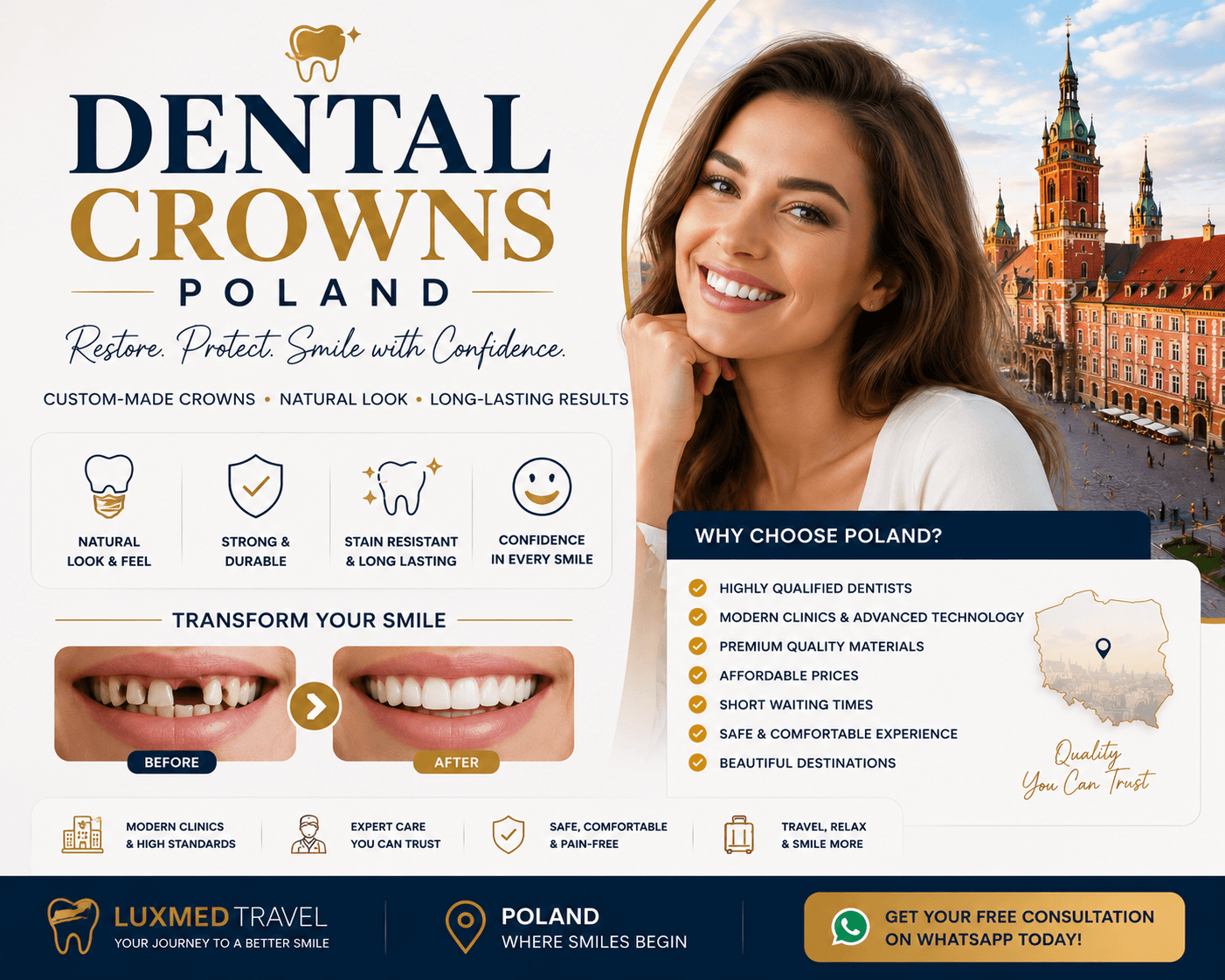
Dental Crowns Poland is a popular search for patients who want to restore damaged, worn, weakened or unattractive teeth through private dental treatment abroad. A dental crown is a custom-made cap that covers a natural tooth or dental implant. It can help improve tooth strength, shape, size, colour and function when a filling, bonding or veneer is not enough.
Many patients consider dental crowns because they want a stronger and more natural-looking smile. Crowns may be used after root canal treatment, to restore broken teeth, to protect teeth with large fillings, to improve worn teeth, to cover dental implants or to support a complete smile restoration plan.
At LuxMedTravel, we help international patients explore dental crown options in Poland with clinic matching, consultation coordination, treatment planning, travel support and aftercare guidance. Whether you are travelling from the UK, Ireland or another European country, our team can help you understand the process and request a personalised treatment plan.
Estimated package cost: Please consult us for the best price options in Poland.
What Are Dental Crowns?
Dental crowns are tooth-shaped restorations that cover the visible part of a tooth. They are sometimes called caps because they sit over the prepared tooth and restore its shape, strength and appearance. A crown may be made from different materials, including zirconia, porcelain, ceramic, porcelain-fused-to-metal or other dental materials depending on the case.
A dental crown may be recommended when a tooth is too damaged or weak for a standard filling. It may also be used for cosmetic improvement when the tooth needs full coverage rather than a small surface treatment.
Dental crowns may be used to:
- Restore a broken tooth
- Protect a weak tooth
- Cover a tooth with a large filling
- Restore a tooth after root canal treatment
- Improve the shape of a tooth
- Improve tooth colour
- Restore worn teeth
- Support a dental bridge
- Cover a dental implant
- Improve smile appearance
- Complete a full mouth restoration plan
Dental crowns should always be planned carefully. The dentist must assess the tooth structure, gum health, bite, smile line, colour match, oral hygiene and long-term function before recommending treatment.
Why Consider Dental Crowns in Poland?
Poland has become a popular destination for private dental treatment among international patients. Many people researching dental crowns abroad consider Poland because of its European location, modern private dental clinics, experienced dental teams and accessible travel routes from the UK and other European countries.
Patients may consider dental crowns in Poland because of:
- Private cosmetic and restorative dentistry options
- Access to experienced dental teams
- Modern dental clinics and digital imaging technology
- Zirconia, porcelain and ceramic crown options
- Smile restoration planning
- English-speaking patient coordination
- Travel and accommodation guidance
- Treatment planning support before travel
- Personalised aftercare communication
Cities such as Warsaw, Kraków, Wrocław, Poznań and Gdańsk are commonly researched by international patients considering dental treatment in Poland. The most suitable city or clinic depends on the number of crowns, treatment complexity, dental lab availability, travel route and follow-up needs.
LuxMedTravel can help you compare suitable options and understand the steps before making a decision.
Who May Be Suitable for Dental Crowns?
Dental crowns may be suitable for patients who have damaged, weakened, heavily filled, broken, worn or cosmetically compromised teeth. Crowns may also be used as part of dental implant treatment or a full smile restoration plan.
You may be considered for dental crowns if:
- You have broken or cracked teeth
- You have teeth weakened by large fillings
- You have worn-down teeth
- You have discoloured teeth that cannot be improved with whitening
- You have misshapen teeth
- You have had root canal treatment
- You need crowns over dental implants
- You need to support a dental bridge
- You want a more uniform smile
- You are planning a smile makeover
- You have realistic expectations
- You can maintain good oral hygiene
Dental crowns may not be suitable immediately if you have active gum disease, untreated decay, infection, unstable bite, poor oral hygiene or teeth that cannot be saved. In some cases, other treatments such as fillings, root canal treatment, gum treatment, orthodontics, veneers, implants or extractions may be more appropriate.
A qualified dentist must assess your teeth before confirming whether crowns are the right option.
Dental Crowns Are Not Only Cosmetic
Many patients think dental crowns are only used for smile design, but crowns can also be functional and protective. They may help strengthen a tooth that has lost much of its natural structure, protect a root canal-treated tooth or restore chewing ability.
Dental crowns can be used for:
- Restorative dentistry
- Cosmetic dentistry
- Implant dentistry
- Smile makeovers
- Bite rehabilitation
- Full mouth reconstruction
- Tooth protection
- Tooth shape correction
The purpose of the crown affects the treatment plan. A crown used to restore a broken molar must be strong enough for chewing. A crown used on a front tooth must match the smile line and natural tooth colour. Implant crowns must fit the implant system and surrounding gum shape.
This is why crown treatment should be planned individually, not as a one-size-fits-all procedure.
Types of Dental Crowns
Dental crowns can be made from different materials. The best material depends on the tooth position, bite force, aesthetic needs, gum line, tooth colour, budget considerations and dentist recommendation.
Zirconia Crowns
Zirconia crowns are popular because they are strong and can provide a natural-looking appearance. They are often used for both front and back teeth depending on the case. Zirconia may be suitable for patients who need durable crowns for chewing areas while still wanting a clean aesthetic result.
Zirconia crowns may be considered for:
- Back teeth exposed to chewing pressure
- Smile restoration
- Patients who need strength and aesthetics
- Implant crowns
- Full mouth crown treatment
- Patients who prefer metal-free restorations
A dentist should assess whether zirconia is the best material for your case.
Porcelain Crowns
Porcelain crowns can provide a highly aesthetic appearance and may be used for visible front teeth. They can be designed to match surrounding natural teeth and create a bright, natural smile.
Porcelain crowns may be considered for:
- Front teeth
- Cosmetic smile restoration
- Colour and shape improvement
- Natural-looking dental aesthetics
- Patients with high smile-line visibility
Porcelain can look beautiful, but material choice must also consider bite forces and tooth condition.
Ceramic Crowns
All-ceramic crowns are another metal-free option. They may be used for patients who want natural aesthetics and do not want metal-based restorations. Different ceramic systems may be used depending on clinic technology and treatment goals.
Porcelain-Fused-to-Metal Crowns
Porcelain-fused-to-metal crowns combine a metal base with porcelain covering. They have been used in dentistry for many years. They may be strong, but in some cases the metal layer can affect aesthetics, especially near the gum line.
Some patients replacing older crowns may choose zirconia or all-ceramic crowns for a more natural-looking result.
Implant Crowns
An implant crown is a crown attached to a dental implant rather than a natural tooth. It is used to restore a missing tooth after implant placement and healing. Implant crowns require careful planning because the crown must connect properly to the implant and look natural at the gum line.
Dental Crowns vs Veneers
Dental crowns and veneers are often confused, but they are different treatments.
A veneer is a thin shell that usually covers only the front surface of a tooth. It is often used for cosmetic changes when the tooth is generally healthy. A crown covers the entire visible part of the tooth and may be used when the tooth needs more strength, protection or full coverage.
Veneers may be suitable for:
- Minor cosmetic changes
- Front tooth appearance
- Mild discolouration
- Small gaps
- Shape improvement
- Teeth with enough healthy structure
Crowns may be more suitable for:
- Broken teeth
- Heavily filled teeth
- Root canal-treated teeth
- Worn teeth
- Teeth needing full coverage
- Dental implant restoration
- Full mouth rehabilitation
A dentist should recommend the most conservative and appropriate option. If a veneer is enough, a crown may not be necessary. If the tooth is weak or damaged, a veneer may not provide enough protection.
Dental Crowns vs Dental Implants
Dental crowns and dental implants are also different. A dental crown restores a tooth or covers an implant. A dental implant replaces a missing tooth root.
If your natural tooth can be saved, a crown may be used to restore it. If the tooth is missing or cannot be saved, a dental implant with an implant crown may be considered.
A crown may be suitable when:
- The tooth root is still healthy enough
- The tooth can be restored
- Decay or damage can be treated
- The tooth has enough support
- Root canal treatment has been completed if needed
A dental implant may be considered when:
- The tooth is missing
- The tooth cannot be saved
- Extraction is needed
- A fixed tooth replacement is desired
- Bone condition is suitable
The right option depends on dental examination, X-rays, tooth condition, gum health and your long-term treatment goals.
Dental Crowns Poland: How the Process Works
LuxMedTravel supports patients throughout the treatment planning process. The aim is to make each step clearer before you travel.
1. Initial Enquiry
You contact our team through WhatsApp, phone or the enquiry form. We ask about your dental concerns, number of teeth involved, previous dental treatment, current symptoms and preferred travel dates.
2. Dental Pre-Assessment
For crown planning, clinics may request dental photos, X-rays or a panoramic scan. If you already have dental images, you can share them during the enquiry process. This helps the dental team understand whether crowns may be suitable or whether other treatment is needed first.
You may be asked about:
- Number of teeth you want treated
- Broken or damaged teeth
- Previous root canal treatment
- Existing crowns or bridges
- Gum bleeding or gum disease
- Tooth sensitivity
- Bite problems
- Teeth grinding
- Missing teeth
- Medical conditions
- Current medications
- Smoking status
- Desired smile result
3. Clinic and Dentist Matching
Based on your case, LuxMedTravel helps coordinate with suitable dental clinics in Poland. The goal is to connect you with an appropriate provider for cosmetic and restorative dentistry consultation.
4. Personalised Treatment Plan
After assessment, you may receive a personalised treatment plan. This may include the number of crowns, recommended material, whether root canal treatment is needed, whether old crowns need replacement, whether gum treatment is required, expected visits, accommodation guidance, transfer support and aftercare instructions.
5. Travel to Poland
Depending on your selected clinic and treatment plan, you may travel to Warsaw, Kraków, Wrocław, Poznań, Gdańsk or another suitable dental destination in Poland. Our team can help with practical travel planning before your visit.
6. Tooth Preparation
During the crown procedure, the dentist prepares the tooth so the crown can fit properly. This usually involves reshaping the tooth. If the tooth is damaged or decayed, the dentist may need to treat it first. In some cases, root canal treatment may be required before the crown is fitted.
7. Impressions or Digital Scan
After preparation, the clinic takes impressions or a digital scan of your teeth. This allows the dental lab or digital system to design crowns that fit your bite and smile.
8. Temporary Crowns
In many cases, temporary crowns are placed while the final crowns are being made. Temporary crowns protect the prepared teeth and allow you to function during the waiting period.
9. Final Crown Fitting
When the final crowns are ready, the dentist checks the fit, bite, colour and shape before bonding or cementing them in place. Adjustments may be made to improve comfort and function.
10. Follow-Up and Maintenance
After crown placement, good oral hygiene and regular dental check-ups are important. Crowns can last for many years, but they still need care and monitoring.
What May Be Included in a Dental Crown Package?
Package details may vary depending on the clinic, number of crowns, crown material and treatment complexity. A personalised dental crown treatment plan may include:
- Online consultation support
- Dental clinic coordination
- Cosmetic dentist assessment
- Dental X-ray or scan review
- Smile assessment
- Treatment planning
- Tooth preparation
- Digital scan or impressions
- Temporary crowns, if required
- Final crowns
- Bite adjustment
- Crown fitting
- Hotel or accommodation support
- Airport and clinic transfer support
- English-speaking patient coordination
- Aftercare instructions
- Follow-up communication
The final package depends on the number of crowns, selected material, tooth condition, whether root canal or gum treatment is needed, clinic selection, laboratory process, number of visits, accommodation, transfers and aftercare needs.
Estimated package cost: Please consult us for the best price options in Poland.
How Many Visits Are Needed for Dental Crowns in Poland?
The number of visits depends on the treatment plan, number of crowns and clinic technology. Some crown treatments may be completed in a shorter timeframe, while more complex smile restoration or full mouth crown treatment may need several appointments.
A typical crown journey may include:
- Consultation and assessment
- X-rays or scans
- Tooth preparation
- Impressions or digital scan
- Temporary crowns
- Dental lab design
- Final crown fitting
- Bite adjustment
- Follow-up review
If root canal treatment, gum treatment, tooth extraction, implant placement or old crown replacement is needed, the timeline may be longer.
Patients travelling from abroad should understand the expected visit schedule before booking flights.
Dental Crowns for Smile Makeover
Dental crowns may be used as part of a smile makeover when teeth are damaged, heavily restored, discoloured, worn or uneven. Crowns can improve shape, colour and alignment appearance, but they require more tooth preparation than some cosmetic alternatives.
A crown-based smile makeover may help with:
- Worn teeth
- Broken teeth
- Dark or discoloured teeth
- Old crowns
- Uneven tooth shape
- Large fillings
- Bite-related wear
- Full smile restoration
- Implant-supported teeth
However, not every smile concern needs crowns. Some patients may be better suited to whitening, bonding, orthodontics or veneers. A responsible dental clinic should recommend the least invasive suitable option.
Zirconia Crowns Poland
Zirconia crowns are commonly researched by patients seeking dental crowns in Poland. They are popular because they can offer strength and a clean aesthetic appearance. Zirconia crowns may be used for single teeth, multiple teeth, implant crowns or full mouth restorations depending on the case.
Zirconia crowns may be considered for:
- Patients who want strong crowns
- Back teeth exposed to chewing forces
- Front teeth in selected aesthetic cases
- Implant-supported crowns
- Full mouth rehabilitation
- Metal-free dental restoration
- Replacement of older crowns
The final appearance depends on crown design, colour matching, gum condition, dental lab quality and dentist planning. A consultation is needed to confirm whether zirconia is suitable for your teeth.
Porcelain Crowns Poland
Porcelain crowns may be chosen for patients who want a natural-looking restoration, especially in visible areas of the smile. Porcelain can be matched to surrounding teeth and can provide attractive translucency when planned well.
Porcelain crowns may be suitable for:
- Front teeth
- Cosmetic smile areas
- Natural tooth colour matching
- Aesthetic tooth restoration
- Patients wanting a highly natural appearance
Porcelain crowns may not be the best option for every back tooth or for patients with strong grinding habits. Material selection should always be personalised.
Replacing Old Dental Crowns
Some patients travel for dental crowns in Poland because they want to replace old crowns. Older crowns may become worn, discoloured, loose, poorly fitted or less natural-looking over time. In some cases, gum recession can reveal dark margins around older crowns.
Old crown replacement may be considered if:
- Crowns look dark or unnatural
- Crown margins are visible
- Crowns are loose
- There is decay under the crown
- The bite feels uncomfortable
- The crown has cracked or chipped
- Gum irritation is present
- The patient wants a more natural smile
Before replacing old crowns, the dentist must check the tooth underneath. If there is decay, infection or root problems, these must be treated before new crowns are fitted.
Full Mouth Dental Crowns
Full mouth dental crowns may be considered for patients with widespread tooth wear, multiple damaged teeth, old restorations or complex smile rehabilitation needs. This is a major restorative plan and should not be rushed.
Full mouth crown treatment may involve:
- Bite analysis
- Smile design
- X-rays or scans
- Gum assessment
- Root canal assessment
- Old restoration removal
- Temporary crowns
- Final crown fitting
- Bite adjustment
- Long-term maintenance planning
This type of treatment requires careful planning because it affects chewing, speech, smile appearance and jaw comfort. Patients should choose a clinic that can explain the full plan clearly.
Recovery and Sensitivity After Dental Crowns
Dental crown treatment is usually less invasive than surgery, but patients may still experience temporary sensitivity or discomfort after tooth preparation or crown fitting. This can happen because the tooth has been reshaped and the bite may need time to adjust.
After crown treatment, you may need to:
- Avoid very hard foods at first
- Avoid sticky foods with temporary crowns
- Brush and floss carefully
- Keep the gum line clean
- Follow bite adjustment advice
- Report persistent pain
- Report crown looseness
- Attend follow-up appointments
- Avoid using teeth to open packages
- Manage grinding if advised
If sensitivity continues, pain becomes severe, or biting feels wrong, the dentist should check the crown. Sometimes a small bite adjustment can improve comfort.
Long-Term Care for Dental Crowns
Dental crowns need regular care. Although the crown itself cannot decay, the natural tooth underneath and the gum line around it can still develop problems. Good oral hygiene is essential.
Long-term care may include:
- Brushing twice daily
- Cleaning between teeth
- Using floss or interdental brushes
- Regular dental check-ups
- Professional hygiene appointments
- Avoiding chewing very hard objects
- Wearing a night guard if you grind your teeth
- Monitoring crown margins
- Reporting pain or looseness early
- Avoiding smoking for better gum health
Crowns can last for many years with proper care, but no dental restoration lasts forever. Some crowns may need repair or replacement in the future.
Benefits of Dental Crowns
For suitable patients, dental crowns may provide both functional and aesthetic benefits. They can restore damaged teeth, improve chewing and create a more balanced smile.
Possible benefits may include:
- Restoring broken teeth
- Strengthening weak teeth
- Protecting root canal-treated teeth
- Improving tooth shape
- Improving tooth colour
- Replacing old restorations
- Supporting dental bridges
- Covering dental implants
- Improving smile appearance
- Supporting full mouth rehabilitation
- Helping restore chewing function
Results depend on tooth condition, material choice, dentist planning, dental lab quality and long-term care.
Risks and Safety Considerations
Dental crown treatment is common, but it still carries risks and limitations. A dentist should explain the benefits, alternatives and possible complications before treatment.
Possible risks may include:
- Tooth sensitivity
- Gum irritation
- Discomfort when biting
- Need for root canal treatment
- Crown loosening
- Crown chipping or fracture
- Decay under the crown
- Poor colour match
- Bite problems
- Gum recession
- Allergic reaction to materials, rarely
- Need for crown replacement in the future
- Unsatisfactory aesthetic result
Your personal risk depends on tooth condition, gum health, oral hygiene, bite, grinding habits, material choice and treatment planning.
Choosing the right clinic, dentist and aftercare plan is important. LuxMedTravel helps patients ask the right questions, understand their options and prepare for dental treatment abroad more carefully.
Dental Crowns Abroad: Important Safety Points
Planning dental crown treatment abroad requires careful preparation. Patients should think not only about the appearance of the crowns, but also about tooth health, gum health, bite comfort, material quality and long-term maintenance.
Before choosing dental crowns abroad, consider:
- Dentist experience in cosmetic and restorative dentistry
- Clinic standards and technology
- Whether X-rays or scans are reviewed
- Whether gum health is assessed
- Whether root canal treatment is needed
- Which crown materials are available
- Whether temporary crowns are included
- How many visits are required
- What happens if a crown feels uncomfortable
- What aftercare is included
- Whether follow-up can be arranged
- How old crowns or decay will be managed
- Whether the treatment plan is too aggressive
You should not feel rushed into full mouth crowns without proper explanation. A safe and ethical dental plan should protect natural teeth as much as possible.
Preparing for Dental Crowns in Poland
Preparation is important for organised dental treatment abroad. Before dental crown treatment, the clinic may provide instructions based on your oral health and treatment plan.
Preparation may include:
- Dental history review
- Medical history review
- Medication review
- Allergy information
- Dental photos
- Panoramic X-ray or scan
- Gum health assessment
- Bite assessment
- Root canal assessment
- Old crown assessment
- Smile design planning
- Travel planning
- Accommodation planning
- Follow-up planning after returning home
You should be honest about dental pain, sensitivity, gum bleeding, grinding, previous root canal treatment, medical conditions and expectations. Accurate information helps the dental team plan more safely.
Local Treatment Planning in Poland
Poland offers several cities that may be suitable for international dental crown patients. Depending on clinic availability and treatment complexity, patients may consider dental crown treatment in or near Warsaw, Kraków, Wrocław, Poznań or Gdańsk.
Each city may offer different practical advantages:
- Warsaw is a major international travel hub with strong transport connections.
- Kraków is popular with international visitors and has convenient travel routes.
- Wrocław may be suitable for selected private dental clinics.
- Poznań can be convenient for patients considering western Poland access.
- Gdańsk may be suitable for patients looking at northern Poland routes.
The best location depends on the clinic, dentist, treatment plan, dental lab timeline and your travel needs. LuxMedTravel can help you understand which option may be more suitable for your case.
Questions to Ask Before Choosing a Dental Crown Clinic
Before choosing a dental crown clinic, you should feel informed and confident. Important questions may include:
- Is the dentist experienced in cosmetic and restorative dentistry?
- Do I really need crowns, or would veneers, bonding or whitening be enough?
- Which crown material is suitable for my case?
- Do I need zirconia, porcelain or another material?
- Will X-rays or scans be reviewed before treatment?
- Is root canal treatment needed?
- Are my gums healthy enough for crowns?
- How many teeth should be treated?
- Will temporary crowns be provided?
- How many visits are needed?
- How will the colour be matched?
- How will my bite be checked?
- What happens if a crown feels uncomfortable?
- What aftercare is included?
- How long should crowns last with proper care?
- Will I need a night guard if I grind my teeth?
- How will follow-up be handled after I return home?
A good consultation should provide clear answers, realistic expectations and a personalised treatment plan.
Estimated Package Cost
Estimated package cost: Please consult us for the best price options in Poland.
The final package cost depends on the number of crowns, crown material, selected clinic, tooth condition, need for root canal treatment, gum treatment, old crown removal, temporary crowns, laboratory process, number of visits, accommodation, transfers and aftercare plan. Because dental crown treatment is personalised, we recommend contacting our team for a tailored consultation instead of relying on a fixed online price.
Contact LuxMedTravel today and we will help you explore suitable dental crown options in Poland.
Frequently Asked Questions About Dental Crowns Poland
What are dental crowns?
Dental crowns are custom-made caps that cover a natural tooth or dental implant. They can restore shape, strength, colour, size and function.
Who is suitable for dental crowns in Poland?
Suitability depends on tooth condition, gum health, bite, oral hygiene and treatment goals. A dentist must assess your case before confirming whether crowns are appropriate.
Are dental crowns only cosmetic?
No. Crowns can be cosmetic, restorative or protective. They may be used for broken teeth, root canal-treated teeth, large fillings, implant restorations or smile improvement.
What is the difference between crowns and veneers?
Veneers usually cover only the front surface of teeth and are mainly cosmetic. Crowns cover the whole visible part of the tooth and may be used when the tooth needs more strength or protection.
What is the difference between crowns and implants?
A crown covers a tooth or implant. A dental implant replaces a missing tooth root. If a tooth is missing, an implant and implant crown may be needed.
Which crown material is best?
The best material depends on tooth position, bite force, aesthetics, gum line, budget considerations and dentist recommendation. Zirconia, porcelain and ceramic crowns may all be suitable in different cases.
Are zirconia crowns good?
Zirconia crowns can be strong and natural-looking when planned well. They may be suitable for front teeth, back teeth, implant crowns or full mouth restorations depending on the case.
Do dental crowns hurt?
The procedure is usually performed with local anaesthesia when needed. Some sensitivity or discomfort may occur after tooth preparation or crown fitting, but persistent pain should be checked by a dentist.
How many visits are needed for dental crowns in Poland?
The number of visits depends on the number of crowns, clinic technology, lab timeline and whether other treatments are needed. Some cases require several appointments.
Can I get a fixed dental crown price online?
We recommend requesting a personalised consultation. The final package depends on the number of crowns, material, tooth condition, clinic selection, visits, accommodation, transfers and aftercare. Please consult us for the best price options in Poland.
How long do dental crowns last?
Dental crowns can last for many years with proper care, but they may eventually need repair or replacement. Longevity depends on oral hygiene, bite, material, grinding habits and regular dental check-ups.
Can decay happen under a crown?
Yes. The crown itself cannot decay, but the natural tooth underneath and the margin around the crown can develop decay if oral hygiene is poor or the crown does not fit properly.
Can old crowns be replaced?
Yes, old crowns can often be replaced if they are worn, damaged, loose, unattractive or causing problems. The dentist must check the tooth underneath before planning replacement.
Do I need root canal treatment before a crown?
Not always. Some teeth need root canal treatment before a crown, especially if the nerve is damaged or infected. Other teeth can be crowned without root canal treatment.
How do I start my dental crown consultation in Poland?
You can contact LuxMedTravel by WhatsApp, phone or enquiry form. Our team will collect your basic details and help guide you through the next steps.
Call to Action
Considering dental crowns in Poland?
Contact LuxMedTravel today for a personalised consultation, clinic matching and treatment planning support.
Estimated package cost: Please consult us for the best price options in Poland.
Speak with our team on WhatsApp or send your enquiry now.