
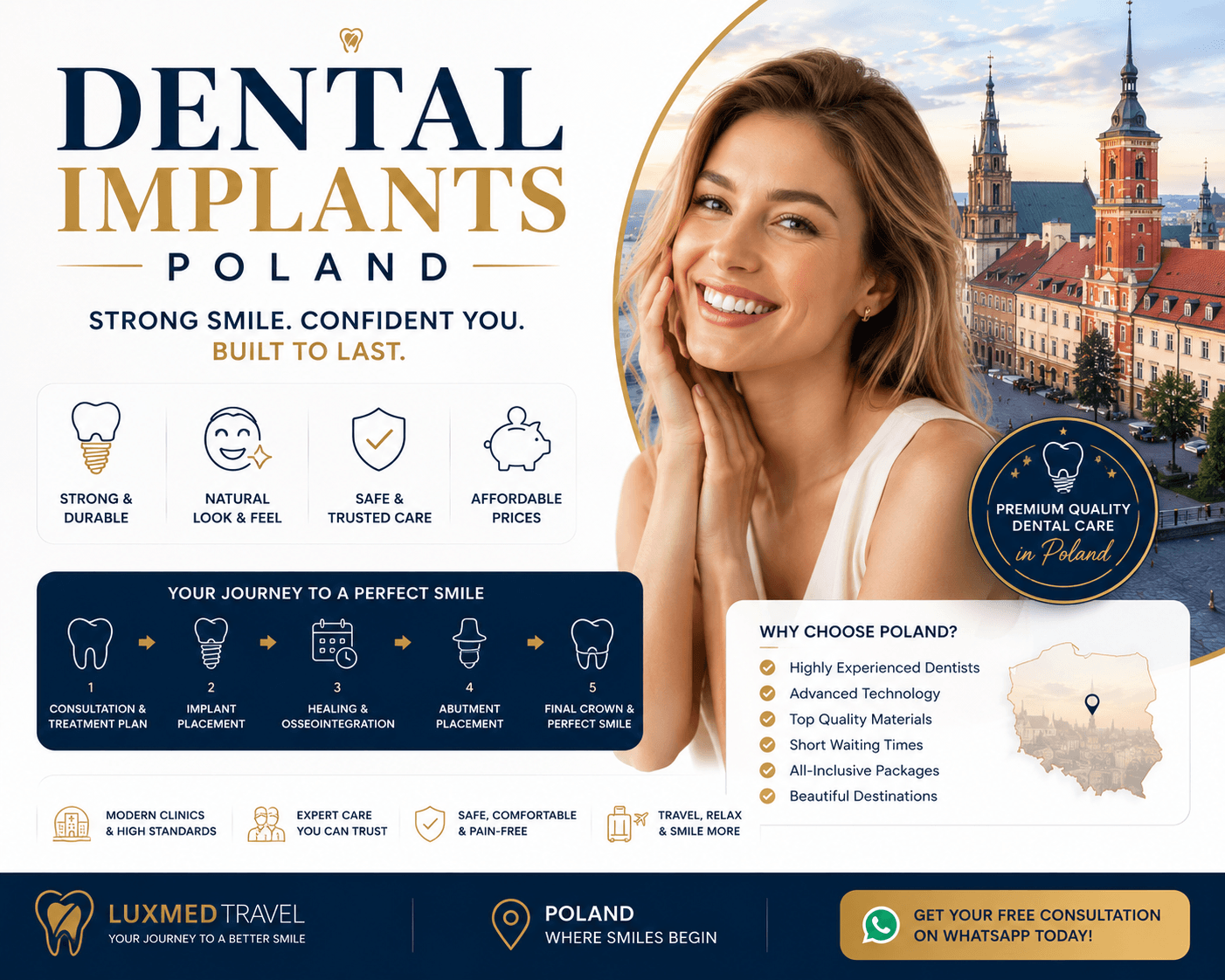
Dental Implants Poland is a popular search for patients who are missing one or more teeth and want to explore private dental treatment options abroad. Dental implants are designed to replace missing tooth roots and support artificial teeth such as crowns, bridges or full-arch restorations. They can be used for a single missing tooth, several missing teeth or more complex full mouth rehabilitation plans.
For many patients, dental implants are not only about improving appearance. Missing teeth can affect chewing, speaking, confidence, facial support and long-term oral function. A well-planned implant treatment should consider your oral health, bone structure, gum condition, bite, medical history and long-term maintenance.
At LuxMedTravel, we help international patients explore dental implant options in Poland with clinic matching, consultation coordination, travel planning support and aftercare guidance. Whether you are travelling from the UK, Ireland or another European country, our team can help you understand the process and request a personalised treatment plan.
Estimated package cost: Please consult us for the best price options in Poland.
What Are Dental Implants?
Dental implants are artificial tooth roots that are placed into the jawbone to support replacement teeth. They are usually made from biocompatible materials such as titanium or zirconia. After placement, the implant needs time to integrate with the surrounding bone. This healing process is called osseointegration.
Once the implant has healed and is stable, it can support a dental crown, bridge or denture. Depending on the case, implants may be used to replace:
- One missing tooth
- Several missing teeth
- A full upper arch
- A full lower arch
- Both upper and lower arches
- Teeth that cannot be restored with standard dental treatment
Dental implants are different from removable dentures because they are fixed into the jawbone. They are also different from traditional bridges because they do not always require preparation of neighbouring healthy teeth.
A dental implant treatment plan should always be personalised. The dentist or implant surgeon must assess your bone level, gum health, bite, oral hygiene, medical history and expectations before recommending treatment.
Why Consider Dental Implants in Poland?
Poland has become a popular destination for private dental treatment among international patients. Many people researching dental implants abroad consider Poland because of its European location, modern private dental clinics, experienced dental teams and accessible travel routes from the UK and other European countries.
Patients may consider dental implants in Poland because of:
- Private implant dentistry consultation options
- Access to experienced dental implant teams
- Modern dental clinics and imaging technology
- Treatment planning support before travel
- English-speaking patient coordination
- Travel and accommodation guidance
- Multi-stage treatment planning
- Personalised aftercare communication
- Opportunity to organise dental care with travel support
Cities such as Warsaw, Kraków, Wrocław, Poznań and Gdańsk are commonly researched by international patients considering dental treatment in Poland. The most suitable city or clinic depends on your treatment complexity, number of implants, bone condition, dentist availability, travel route and follow-up needs.
LuxMedTravel can help you compare suitable options and understand the steps before making a decision.
Who May Be Suitable for Dental Implants?
Dental implants may be suitable for patients who are missing teeth and want a fixed or more stable replacement option. However, suitability depends on your oral health, jawbone condition, gum health and general medical profile.
You may be considered for dental implants if:
- You have one or more missing teeth
- You have loose or uncomfortable dentures
- You want a fixed tooth replacement option
- You have enough jawbone to support implants
- Your gums are healthy or can be treated first
- You can maintain good oral hygiene
- You are in good general health
- You have realistic expectations
- You can attend follow-up appointments
- You understand that implant treatment may require more than one visit
Dental implants may not be suitable immediately if you have active gum disease, untreated tooth infection, insufficient bone, uncontrolled diabetes, heavy smoking, poor oral hygiene or certain medical risks. In some cases, these issues can be managed before implant treatment begins.
A qualified implant dentist or oral surgeon must assess your case before confirming whether dental implants are appropriate.
Dental Implant Treatment Is a Personalised Process
Dental implant treatment is not the same for every patient. Some people need a single implant and crown. Others need bone grafting, sinus lift, extractions, temporary teeth, full mouth planning or staged treatment over several months.
A proper dental implant plan may consider:
- Number of missing teeth
- Condition of remaining teeth
- Jawbone volume
- Gum health
- Bite and jaw relationship
- Smile line
- Medical history
- Smoking status
- Oral hygiene
- Aesthetic expectations
- Time available for travel
- Need for temporary teeth
- Long-term maintenance
This is why fixed online packages can be misleading. Two patients may both search for “dental implants Poland”, but one may need a simple single implant while another may require full mouth rehabilitation.
LuxMedTravel helps patients request a personalised assessment before making travel plans.
Types of Dental Implant Treatments
Dental implants can be used in different ways depending on how many teeth need replacing and what type of restoration is planned.
Single Tooth Implant
A single tooth implant may be used when one tooth is missing or needs to be removed. The implant is placed into the jawbone and later restored with a crown.
This option can help replace a missing tooth without preparing neighbouring teeth for a traditional bridge. Suitability depends on bone level, gum condition and available space.
Multiple Dental Implants
Multiple implants may be recommended when several teeth are missing. Depending on the case, each missing tooth may not need its own implant. Sometimes implants can support a dental bridge that replaces several teeth.
The final plan depends on the number of missing teeth, bite forces, bone quality and the position of the gaps.
Implant-Supported Bridge
An implant-supported bridge can replace several missing teeth using fewer implants than the number of teeth being replaced. This may be useful when multiple teeth are missing in the same area.
The dentist must carefully plan implant positions so the bridge is stable, functional and cleanable.
Implant-Supported Denture
An implant-supported denture may provide more stability than a traditional removable denture. Some dentures can clip onto implants, while others may be fixed depending on the plan.
This option may be considered for patients who struggle with loose dentures but may not need or want a full fixed bridge.
Full Mouth Dental Implants
Full mouth dental implants may be considered when most or all teeth are missing, failing or unsuitable for restoration. This type of treatment requires detailed planning because it affects the whole bite, smile and oral function.
Patients researching full mouth dental implants Poland should understand that the treatment may involve extractions, temporary teeth, several implants, healing time and final prosthetic teeth.
All-on-4 Dental Implants
All-on-4 dental implants are a full-arch treatment concept where a full set of teeth is supported by four strategically placed implants in one jaw. In some cases, more than four implants may be recommended depending on bone quality and treatment goals.
All-on-4 may be suitable for selected patients, but it is not right for everyone. Some patients may need bone grafting, additional implants or a different restoration type.
Dental Implants Poland: How the Process Works
LuxMedTravel supports patients throughout the treatment planning process. The aim is to make each step clearer before you travel.
1. Initial Enquiry
You contact our team through WhatsApp, phone or the enquiry form. We ask about your dental concerns, missing teeth, current symptoms, previous treatment, medical history and preferred travel dates.
2. Dental Pre-Assessment
For dental implant planning, clinics often request dental photos, X-rays or a panoramic scan. In many cases, a 3D CBCT scan may be needed to evaluate bone volume and implant position. If you already have dental images, you can share them during the enquiry process.
You may be asked about:
- Number of missing teeth
- Loose or painful teeth
- Gum disease history
- Previous dental implants
- Current dentures or bridges
- Medical conditions
- Current medications
- Smoking status
- Allergies
- Desired result
- Available travel dates
- Previous dental X-rays or scans
3. Clinic and Dentist Matching
Based on your case, LuxMedTravel helps coordinate with suitable dental clinics in Poland. The goal is to connect you with an appropriate provider for implant dentistry consultation and treatment planning.
4. Personalised Treatment Plan
After assessment, you may receive a personalised treatment plan. This may include the number of implants, type of restoration, possible extractions, bone grafting needs, healing stages, estimated visits, accommodation guidance, transfer support and aftercare instructions.
5. Travel to Poland
Depending on your selected clinic and treatment plan, you may travel to Warsaw, Kraków, Wrocław, Poznań, Gdańsk or another suitable dental destination in Poland. Our team can help with practical travel planning before your visit.
6. Implant Placement
During implant placement, the dental team places the implant into the jawbone. The procedure may be performed under local anaesthesia, sedation or another option depending on clinic protocol and patient needs.
Some patients may receive temporary teeth, while others may need a healing period before the final restoration.
7. Healing and Osseointegration
After implant placement, the implant needs time to integrate with the jawbone. This healing stage is essential for implant stability. The length of healing can vary depending on the patient, bone quality and treatment type.
8. Final Teeth or Restoration
Once the implant has healed and is stable, the final crown, bridge or full-arch restoration can be fitted. In full mouth cases, several stages may be needed to achieve the final result.
9. Follow-Up and Maintenance
Dental implants require long-term care. Regular cleaning, dental check-ups and proper oral hygiene are important to reduce the risk of gum inflammation, infection and implant failure.
What May Be Included in a Dental Implant Package?
Package details may vary depending on the clinic, number of implants, restoration type and treatment complexity. A personalised dental implant treatment plan may include:
- Online consultation support
- Dental clinic coordination
- Implant dentist or oral surgeon assessment
- Dental X-ray or scan review
- Treatment planning
- Tooth extraction, if required
- Implant placement
- Temporary teeth, if suitable
- Healing guidance
- Abutment placement
- Final crown, bridge or full-arch restoration
- Hotel or accommodation support
- Airport and clinic transfer support
- English-speaking patient coordination
- Aftercare instructions
- Follow-up communication
The final package depends on your oral health, number of implants, selected clinic, scan findings, bone condition, restoration type, required visits, accommodation, transfers and aftercare needs.
Estimated package cost: Please consult us for the best price options in Poland.
How Many Visits Are Needed for Dental Implants in Poland?
Dental implant treatment may require more than one visit, especially when healing time is needed before the final restoration. The number of visits depends on your treatment plan.
A typical implant journey may include:
- Consultation and scans
- Extractions, if required
- Implant placement
- Healing period
- Impression or digital scan
- Final crown, bridge or full-arch fitting
- Follow-up and maintenance
Some cases can include temporary teeth earlier in the process, while others require a staged plan. Full mouth dental implants may involve a more complex timeline than a single implant.
Patients travelling from abroad should plan carefully and understand how many visits may be required before booking treatment.
Full Mouth Dental Implants Poland
Full mouth dental implants may be suitable for patients who have many missing, failing or heavily damaged teeth. This type of treatment can help restore chewing function, smile appearance and confidence.
Full mouth implant treatment may involve:
- Removing failing teeth
- Placing several implants
- Temporary teeth
- Healing period
- Final bridge or full-arch restoration
- Bite planning
- Smile design
- Long-term maintenance
Full mouth implant treatment is more complex than a single implant. It requires careful diagnosis, imaging, prosthetic planning and follow-up. Patients should avoid choosing a treatment only because it sounds quick or simple. The safest plan is the one that fits your oral health and bone structure.
All-on-4 Dental Implants Poland
All-on-4 dental implants are a full-arch treatment option that may replace a full set of upper or lower teeth using four implants in one jaw. It is often researched by patients who want fixed teeth instead of removable dentures.
All-on-4 may be considered when:
- A full arch of teeth is missing
- Existing teeth are failing
- Dentures are uncomfortable
- Bone condition is suitable
- The patient wants a fixed full-arch solution
- The bite can be planned safely
However, not every patient is suitable for All-on-4. Some may need additional implants, bone grafting or a different approach. A full assessment and scan are needed before confirming the treatment plan.
Bone Grafting and Sinus Lift
Some patients do not have enough jawbone to support dental implants immediately. This can happen after long-term tooth loss, gum disease, trauma or infection. In these cases, bone grafting may be recommended.
A bone graft helps rebuild bone volume in the area where an implant is planned. In the upper back jaw, a sinus lift may be needed if the sinus is close to the implant site.
Bone grafting or sinus lift can affect:
- Treatment timeline
- Number of visits
- Healing period
- Implant placement timing
- Final restoration planning
Not every patient needs grafting. A scan is usually required to confirm bone condition.
Recovery After Dental Implant Surgery
Recovery after dental implant surgery depends on the number of implants placed, whether extractions were performed, whether bone grafting was needed and your general health. Mild discomfort, swelling, bruising and tenderness can happen after implant placement.
During recovery, you may need to:
- Take medication as prescribed
- Follow pain relief guidance
- Avoid disturbing the implant area
- Avoid smoking
- Avoid alcohol during early healing
- Eat soft foods if advised
- Avoid hard or crunchy foods
- Keep the mouth clean
- Follow brushing and rinsing instructions
- Avoid strenuous activity for a short period if advised
- Attend follow-up appointments
- Contact the clinic if pain, swelling or bleeding worsens
Good oral hygiene is essential after dental implant treatment. Poor cleaning around implants can lead to gum inflammation and infection around the implant. Smoking can also increase the risk of implant failure.
Long-Term Dental Implant Care
Dental implants need regular maintenance. Although they are not natural teeth, the gums and bone around them must remain healthy. The crowns, bridges or dentures attached to implants also need care and may wear over time.
Long-term care may include:
- Brushing carefully around implants
- Using interdental brushes or floss if advised
- Attending dental check-ups
- Professional hygiene appointments
- Monitoring bite and implant stability
- Avoiding smoking
- Managing teeth grinding if present
- Reporting bleeding, swelling or looseness early
- Maintaining good gum health
Dental implants can last for many years with good planning and maintenance, but no dental treatment can be guaranteed for life. Patients should understand the need for long-term care before starting implant treatment.
Benefits of Dental Implants
For suitable patients, dental implants may offer functional and aesthetic benefits. They can provide a stable foundation for replacement teeth and may help restore confidence when teeth are missing.
Possible benefits may include:
- Replacing missing teeth
- Improved chewing function
- More stable replacement teeth
- Improved smile appearance
- Better speech confidence in some cases
- Support for facial structure
- Alternative to removable dentures
- No need to prepare neighbouring teeth in some single implant cases
- Improved comfort compared with loose dentures
- Long-term restorative option when properly maintained
Results vary depending on oral health, treatment planning, bone condition, restoration type and long-term care.
Risks and Safety Considerations
Dental implant treatment is a surgical dental procedure and carries risks. It should only be considered after proper examination, imaging and consultation with a qualified dental professional.
Possible risks may include:
- Infection
- Bleeding
- Swelling
- Pain or discomfort
- Nerve injury
- Sinus complications in upper jaw implants
- Poor healing
- Implant failure
- Bone graft failure
- Gum recession
- Implant loosening
- Damage to nearby teeth
- Bite problems
- Peri-implantitis
- Need for additional treatment
- Unsatisfactory aesthetic result
Your personal risk depends on your oral health, bone condition, smoking status, medical history, diabetes control, gum health, bite and aftercare habits.
Choosing the right clinic, dentist and aftercare plan is important. LuxMedTravel helps patients ask the right questions, understand their options and prepare for dental treatment abroad more carefully.
Dental Implants Abroad: Important Safety Points
Planning dental implant treatment abroad requires careful preparation. Patients should think not only about the implant placement, but also about scans, treatment stages, temporary teeth, final restoration, aftercare and what happens if there are problems after returning home.
Before choosing dental implants abroad, consider:
- Dentist or oral surgeon qualifications
- Clinic standards and technology
- Use of 3D imaging when needed
- Implant brand and documentation
- Whether the treatment plan is staged or immediate
- Whether extractions are needed
- Whether bone grafting is needed
- How many visits are required
- What temporary teeth are provided
- What aftercare is included
- What happens if an implant does not integrate
- Whether follow-up can be arranged
- How complications are handled after returning home
You should not feel rushed into treatment. A safe dental implant plan should be based on diagnosis, scans and long-term function, not only on speed or appearance.
Preparing for Dental Implants in Poland
Preparation is important for safe and organised dental treatment abroad. Before dental implant treatment, the clinic may provide instructions based on your oral health and treatment plan.
Preparation may include:
- Dental history review
- Medical history review
- Medication review
- Allergy information
- Panoramic X-ray or CBCT scan
- Gum health assessment
- Tooth extraction planning, if needed
- Bone grafting assessment
- Smoking reduction or stopping, if advised
- Oral hygiene preparation
- Travel planning
- Accommodation planning
- Recovery planning
- Follow-up planning after returning home
You should be honest about medical conditions, medications, smoking, gum disease, previous implant problems and dental anxiety. Accurate information helps the dental team plan more safely.
Local Treatment Planning in Poland
Poland offers several cities that may be suitable for international dental implant patients. Depending on clinic availability and treatment complexity, patients may consider implant dentistry in or near Warsaw, Kraków, Wrocław, Poznań or Gdańsk.
Each city may offer different practical advantages:
- Warsaw is a major international travel hub with strong transport connections.
- Kraków is popular with international visitors and has convenient travel routes.
- Wrocław may be suitable for selected private dental clinics.
- Poznań can be convenient for patients considering western Poland access.
- Gdańsk may be suitable for patients looking at northern Poland routes.
The best location depends on the clinic, dentist, treatment plan, number of visits and your travel needs. LuxMedTravel can help you understand which option may be more suitable for your case.
Questions to Ask Before Choosing a Dental Implant Clinic
Before choosing a dental implant clinic, you should feel informed and confident. Important questions may include:
- Is the dentist experienced in dental implant treatment?
- Will I need a 3D CBCT scan?
- How many implants do I need?
- Are any teeth being removed?
- Do I need bone grafting or sinus lift?
- Which implant brand will be used?
- Will I receive implant documentation?
- How many visits are required?
- Will I have temporary teeth?
- How long is the healing period?
- What type of final teeth will be fitted?
- What materials will be used for crowns or bridges?
- What aftercare is included?
- What happens if an implant fails?
- How will follow-up be handled after I return home?
- How should I clean my implants?
- How often do I need maintenance appointments?
A good consultation should provide clear answers, realistic expectations and a personalised treatment plan.
Estimated Package Cost
Estimated package cost: Please consult us for the best price options in Poland.
The final package cost depends on the number of implants, restoration type, selected clinic, scan findings, bone condition, need for extractions, bone grafting, temporary teeth, final crowns or bridges, number of visits, accommodation, transfers and aftercare plan. Because dental implant treatment is highly personalised, we recommend contacting our team for a tailored consultation instead of relying on a fixed online price.
Contact LuxMedTravel today and we will help you explore suitable dental implant options in Poland.
Frequently Asked Questions About Dental Implants Poland
What are dental implants?
Dental implants are artificial tooth roots placed into the jawbone to support replacement teeth such as crowns, bridges or full-arch restorations.
Who is suitable for dental implants in Poland?
Suitability depends on your oral health, jawbone condition, gum health, medical history and expectations. A dental implant professional must assess your case before confirming treatment.
Are dental implants suitable for missing single teeth?
Yes, a single dental implant can replace one missing tooth in suitable patients. The dentist must assess the bone, gum and space before recommending treatment.
Can dental implants replace all teeth?
Yes, full mouth dental implants or full-arch implant restorations may replace all teeth in suitable patients. This requires detailed planning, scans and staged treatment.
What is All-on-4 dental implants?
All-on-4 is a full-arch treatment concept where a full set of teeth is supported by four implants in one jaw. Not every patient is suitable, and a scan is needed before planning.
How many visits are needed for dental implants in Poland?
The number of visits depends on your treatment plan. Some cases require multiple stages, including implant placement, healing and final restoration.
Do I need bone grafting?
Some patients need bone grafting if there is not enough jawbone to support implants. A scan is usually required to confirm whether grafting is needed.
Is dental implant treatment painful?
Dental implant placement is usually performed with local anaesthesia or another pain control option. Discomfort, swelling and tenderness can occur after treatment, and your dental team will provide aftercare instructions.
How long do dental implants take to heal?
Healing time varies depending on bone quality, number of implants, grafting needs and your overall health. The implant must integrate with the bone before the final restoration in many cases.
Can I get a fixed dental implant price online?
We recommend requesting a personalised consultation. The final package depends on the number of implants, scans, bone condition, restoration type, visits, accommodation, transfers and aftercare. Please consult us for the best price options in Poland.
What happens if an implant fails?
If an implant does not integrate or becomes unstable, the dentist may need to remove it, allow healing and plan further treatment. This should be discussed before starting treatment.
How do I clean dental implants?
Implants need careful daily cleaning and regular professional maintenance. Your dentist or hygienist will show you how to clean around the implants and restorations.
Can smoking affect dental implants?
Yes. Smoking can increase the risk of poor healing and implant failure. Patients should discuss smoking honestly with the dental team before treatment.
Are dental implants better than dentures?
Dental implants can provide more stability than removable dentures for suitable patients, but they are not the best option for everyone. The right choice depends on oral health, bone condition, budget, timeline and personal goals.
How do I start my dental implant consultation in Poland?
You can contact LuxMedTravel by WhatsApp, phone or enquiry form. Our team will collect your basic details and help guide you through the next steps.
Call to Action
Considering dental implants in Poland?
Contact LuxMedTravel today for a personalised consultation, clinic matching and treatment planning support.
Estimated package cost: Please consult us for the best price options in Poland.
Speak with our team on WhatsApp or send your enquiry now.